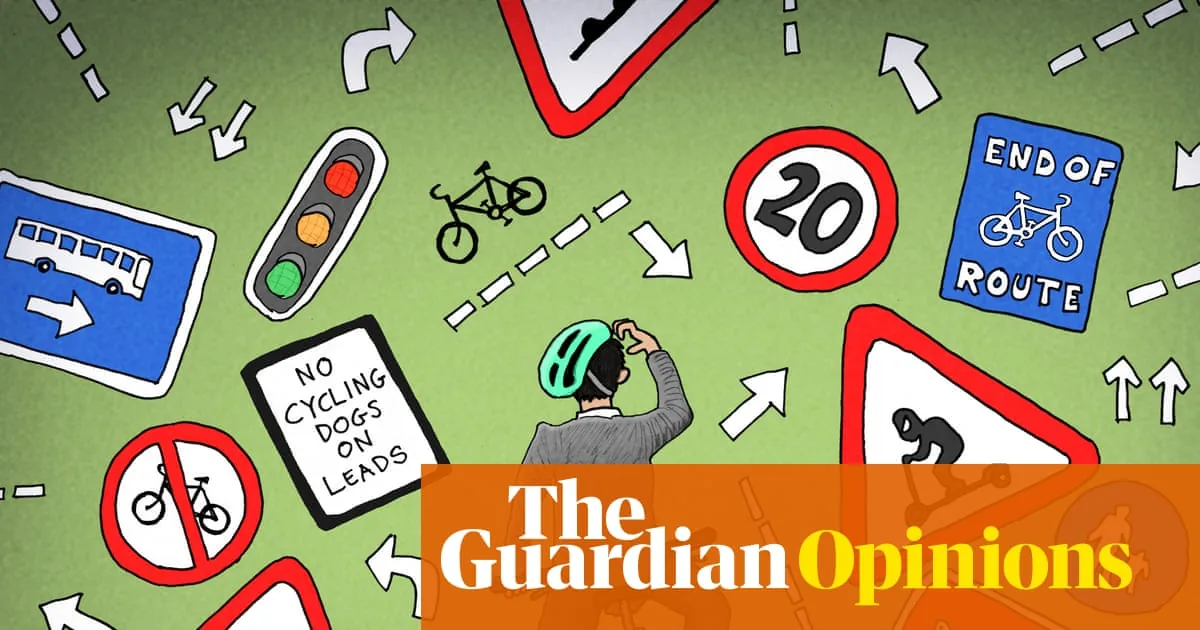
LONDON — Letters to the Guardian have pushed back against arguments that cyclists who run red lights can be excused by complaints about traffic rules. Contributors said the case for ignoring signals misunderstands the idea of shared space and overlooks the risks faced by pedestrians, particularly older and visually impaired people.
One writer said the philosophy associated with Hans Monderman was never meant to allow road users to choose which rules to obey. Another argued that stopping at red lights gives cyclists useful training benefits and a brief rest, while a third said riders who ignore signals fuel hostility towards all cyclists. A fourth described being knocked down twice, including on a pedestrian crossing, and said both riders rode away after checking she was still alive.
Shared space was meant to create caution, not licence to ignore the rules
Gary Ogin of London said references to Hans Monderman’s shared-space approach were being used to justify behaviour that sits outside its purpose. He argued that Monderman did not promote an anything-goes system in which each individual selects which laws to follow. Instead, he said, the point was to remove some infrastructure in order to force people into more careful, mutual negotiation on the road.
Ogin said that balance breaks down once cyclists ignore that process while pedestrians remain exposed. In his view, freedom without universal accountability is not shared space at all, but a system that rewards the most aggressive road user. He warned that the vulnerability of blind, elderly and other pedestrians is what makes compliance essential when streets are designed on shared principles.
He also pointed to the backlash against high-profile schemes such as London’s Exhibition Road, saying the government later halted new level-surface shared-space projects after compliance problems emerged.
Cyclists say stopping can still be part of the ride
Not every letter took the same hard line. Peter Anderson of Barwick-in-Elmet in West Yorkshire, who described himself as a lifelong cyclist, said red lights can have unexpected benefits on a training ride. He said they offer unplanned fartlek opportunities, help with track-stand practice and provide short bursts of effort when setting off again.
He also said that, when tired, a red light can simply be a welcome pause and a chance to drink. Even so, Anderson said Simon Jenkins’s defensive tone about running lights does little to help cyclists’ wider reputation. His point was that the argument is not only about whether a rider can get away with moving through a junction, but about what sort of road culture cyclists want to encourage.
The letter presented stopping as part of everyday riding rather than as an obstacle. That distinction matters because the debate has become as much about behaviour and courtesy as about speed or convenience.
Drivers and riders alike say red-light jumping damages trust on the roads
Edward Collier of Cheltenham said he travels by bicycle, motorbike and car and stops at red lights on all three. He argued that cyclists who ignore signals contribute to rising antagonism towards everyone else on the road. In his view, that makes public frustration worse and leaves law-abiding riders carrying the cost of other people’s behaviour.
Collier said Simon Jenkins should know better. The message from his letter was that resentment builds when some road users are seen to take shortcuts that others would never accept from drivers. That sense of unfairness, he suggested, matters as much as any legal rule because it shapes how people treat cyclists in general.
The letters together showed a strong theme: whatever frustrations road users may have with traffic control, many readers see red-light compliance as central to safety, trust and mutual respect. Several writers argued that once cyclists are seen to break the rules, it becomes harder to defend cycling as part of a cooperative transport system.
Pedestrian injuries and the human cost of careless riding
Joan Grabham of Cambridge gave the most personal account, describing two collisions with cyclists over four years. She said the first happened when she was 83, leaving her with a damaged wrist. The rider, she said, checked whether she was dead before riding away quickly.
Her second collision came in April, when she was 87 and was knocked down on a pedestrian crossing by a black e-bike. She said the crash caused a deep wound on her leg and required police, ambulance and hospital treatment. Four months on, she said, the injury was still being treated.
Grabham’s letter was an angry rebuke to the idea that red-light running can be waved away as a minor transgression. Her account underlined why some readers see the issue not as a quirky cycling habit, but as a matter of real harm to vulnerable pedestrians.
The latest UK news and stories from Bailey Universe.